Medical Aid in 2027: What's Changing, and What to Check Before You Renew
Medical aid prices are going up by around 8% in 2027. The bigger risk isn't the increase. It's renewing on autopilot.
Every year, between September and October, South Africa's medical schemes announce next year's prices and benefits. And every year, most people do the same thing: nothing. The debit order goes up in January, the plan stays the same, and we hope it still fits.
Over the past few weeks we've been running medical aid sessions with the teams we work with, alongside our medical aid advisor. The questions people ask are remarkably consistent. So are the things they miss. This post pulls together what we've learned.
Prefer to watch? Our medical aid session covers how to choose a plan, gap cover and what changes in 2027.Watch the presentation (about 16 minutes)The 2027 increases, in plain numbers
The Council for Medical Schemes recommended increases of around 3.8% for 2027. None of the major schemes came close. Average increases range from 7.35% to 8.9%:
- Bestmed 7.35%
- Medihelp 7.5%
- Momentum, Medshield and Profmed 7.9%
- Discovery Health 8.2%
- Bonitas 8.7%
- Fedhealth 8.9%
So in practice, budget for around 8%. On a R6,000 monthly contribution, that's about R480 a month more, not the R228 that 3.8% would mean.
Two things to keep in mind. First, the schemes are close together, so switching schemes to chase a lower headline number rarely pays off on its own. What you're really choosing between is the benefits. Second, an average isn't your increase. At Discovery, for example, Executive, Comprehensive, Priority and Coastal Core rise by about 8.9%, while the Saver, Smart and Core families rise by about 7.9%. The only number that matters is the one on your own increase notice.
All 2027 figures are still subject to approval by the Council for Medical Schemes.
What's actually new for 2027
Four themes run through this year's announcements:
- Prevention is being paid for. More screenings, and GP visits funded when a screening flags a risk.
- Out-of-pocket costs are being targeted. Some co-payments reduced or removed, and higher specialist limits on some plans.
- Care is moving out of hospital. Virtual chronic care, and hospital-at-home.
- More for families and young earners. New entry-level plans, like Discovery's ActiveCore at R500 per child.
Some schemes are also reaching out to members who've been in hospital with heart-related conditions, as part of new preventative care programmes. If you get that call, take it.
A new plan isn't always a better plan
New, cheaper plans are tempting, especially for younger members. But cheaper usually means something has been taken out. Discovery's new ActiveCore plan is a good example. It's aimed at younger members, but:
- It only covers cancers that are prescribed minimum benefits. Skin cancer, for example, isn't one.
- It doesn't pay for MRI or CT scans out of hospital.
- Its maternity benefit is very limited, as it is on ActiveSmart.
If you're planning to start or grow your family, an entry-level plan is unlikely to be enough. Speak to an advisor before you move.
How to read a plan name
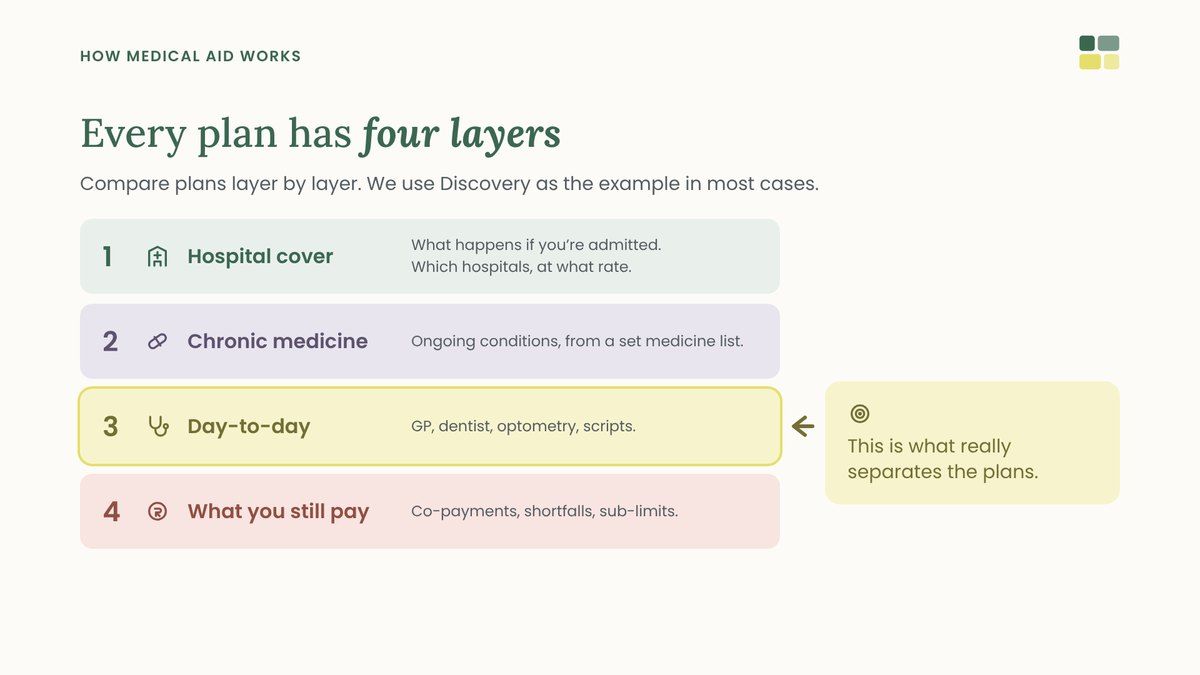
Plan names carry more information than most people realise. Using Discovery as the example:
- "Smart" or "Delta" means you use a network of hospitals. They're two different networks, so check which hospitals are on yours.
- "Core" (Classic Core, Coastal Core, Essential Core) means any hospital, with hospital cover only. You pay day-to-day costs yourself.
- "Coastal" plans are cheaper because healthcare costs less at the coast. The catch: planned procedures are only covered at coastal hospitals. If you've moved inland, you could face a large co-payment for planned care. Emergencies are still covered at the nearest hospital.
Smart plans often surprise people. There's no savings account, but they include some day-to-day cover, like GP visits from around R80 to R130, at a much lower premium than many other options.
Five things to check before your scheme's cut-off
- Know three numbers. Your full monthly contribution, what you actually claimed this year, and what you paid yourself.
- Find your option's increase, not the scheme average. It's on your increase notice.
- Look sideways before you look elsewhere. Moving to another option in the same scheme usually doesn't bring new waiting periods. Moving schemes can.
- Only downgrade if it adds up. A lower premium only saves you money if the benefits you actually use survive the move.
- Beat the cut-off. Most schemes only let you change options once a year, for 1 January. Discovery's deadline is 15 December 2026. Check your own scheme's date.
And one rule that should never be broken: don't cancel your current cover until your new cover is confirmed.
The money you might be leaving on the table
Register your chronic condition. If you have high cholesterol, diabetes, asthma or high blood pressure, ask your GP to register you for chronic cover. It's not just the medicine. Each condition comes with a basket of care. For diabetes, that can include your blood tests, two GP visits a year and a podiatrist visit, paid from your chronic benefit instead of your pocket.
Claim your tax credit. For the 2026/27 tax year, the medical tax credit is R376 a month for you, R376 for your first dependant and R254 for each additional dependant. It goes to whoever actually pays the contributions. If you pay medical aid for a parent or a child who's studying, and it comes from your bank account, you may still be able to claim it.
Submit every claim, even when you pay yourself. On plans with a threshold, those claims count towards unlocking extra cover.
The gap most people don't see
If you check only one thing on your plan, check how it pays specialists. Plans pay at 100%, 200% or 300% of the scheme's own rate, and many specialists charge more. On a plan that pays 100%, you carry the difference. It's the single biggest source of unexpected medical bills.
Gap cover closes that shortfall. It's a separate insurance policy, usually costing a few hundred rand a month, which is often far cheaper than moving up a plan tier for the same protection. And if enough people at one company take it up, the company can apply for a group rate with extra benefits.
Watch the full session
We've turned our medical aid session into a short presentation you can watch in your own time. It covers how every plan is built, how to choose, gap cover, rewards and tax, and what changes in 2027.
Final thought
Medical aid isn't one-size-fits-all, and the right plan for you depends on how you actually use it. The good news is that this is a calculation, not a guess. Run your claims against the options, check the few things that matter, and make the decision before the deadline makes it for you.
If you're on MyBento, our advisors can help you compare your options. Email advice@mybento.net.
