Why Access to Advice Might Be the Most Underrated Employee Benefit
The most expensive decisions are often the ones we delay.
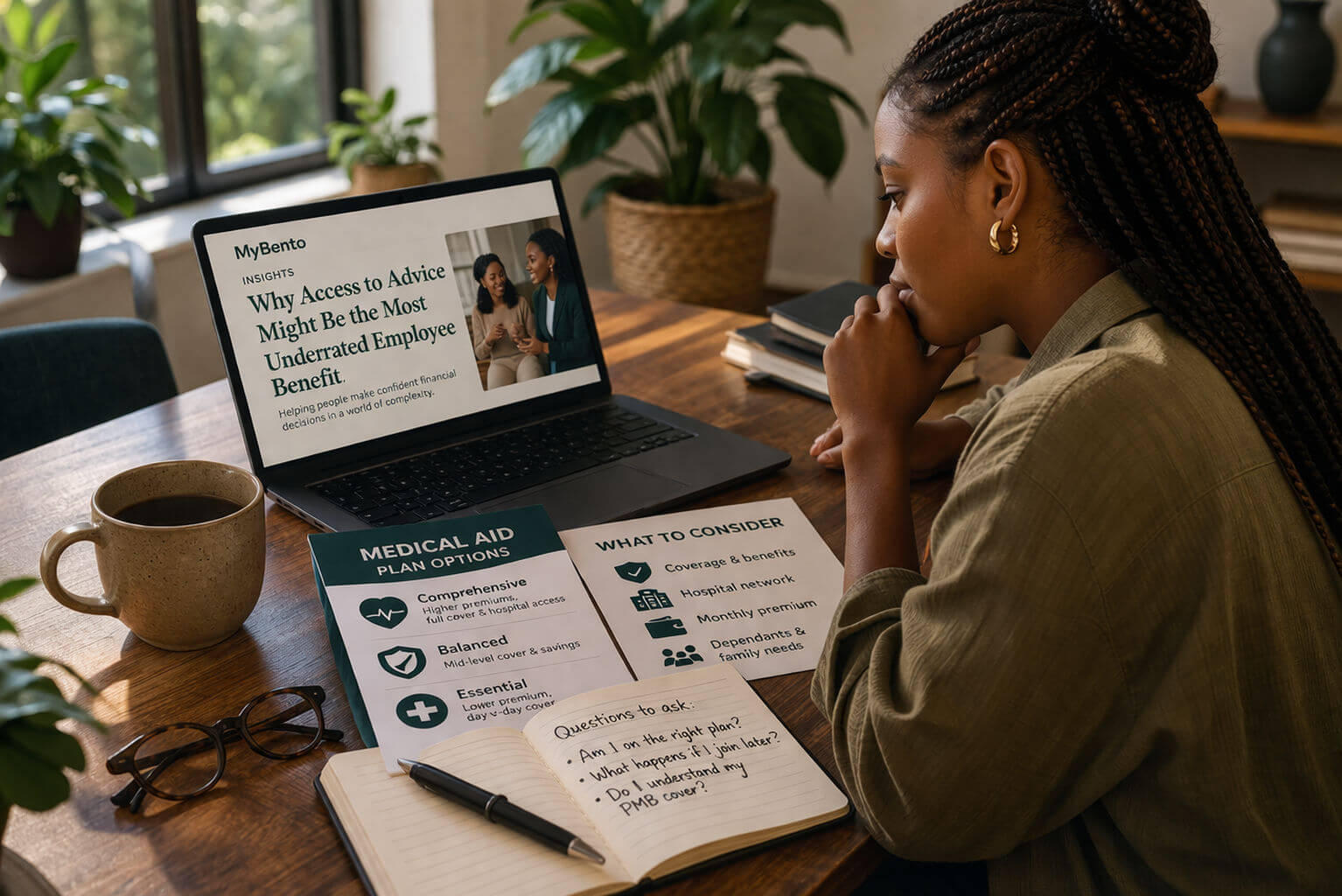
There are few decisions as complex, and as consequential, as financial ones.
Medical aid. Insurance. Retirement. Savings.
Not because the information isn't available. But because there's too much of it. And when faced with complexity, most people don't make a bad decision. They make no decision at all.
This is often referred to as "choice overload" in behavioural economics - where too many options lead to delayed or avoided decisions - and it's a significant driver of poor financial outcomes.
The advice gap is real - and it shows up in everyday decisions
In theory, we live in a world of access:
- Information is everywhere
- Products are widely available
- Comparison tools are a click away
But in practice, something is missing: Context.
Because knowing your options is not the same as knowing what to do. And without context - without someone to sense-check, explain trade-offs, or guide thinking - decisions stall.
What we've been seeing on the ground
Over the past few months, we've been running financial wellbeing sessions with teams across different companies.
The format is simple:
- A group session to unpack key concepts
- Followed by optional 1:1 sessions with an advisor.
What we've observed has been consistent across teams. People are engaged. Curious. Thoughtful. But when it comes to action, many are stuck because they don't feel confident making the decision.
And this is where it becomes real
In almost every session, the same pattern emerges:
People aren't asking: "What's the best product?"
They're asking: "What's right for me?"
And that's a much harder question to answer, especially without guidance.
Medical aid: a case study in complexity
If there's one area where this plays out clearly, it's medical aid.
It's not just a product. It's a system:
- Multiple providers
- Dozens of plans
- Different rules, networks, and structures
Even in our sessions where we simplify things you can feel the overwhelm. People are trying to navigate questions like:
- What's the difference between medical aid and medical insurance?
- Am I on the right plan?
- Am I paying too much - or worse, not covered enough?
And most importantly: What happens if I get this wrong?
What education changes (and what it doesn't)
The group sessions help.
They:
- Break down the jargon
- Create a shared baseline of understanding
- Help people ask better questions
But they don't fully solve the problem.
Because financial decisions are personal.
Where the real shift happens
The biggest shift happens in the 1:1 conversations.
In those sessions:
- Personal context comes into play
- Trade-offs become clearer
- Decisions become tangible
We consistently see people move from: "I don't know where to start" to "This is what makes sense for me" and "I feel confident about my decision."
And sometimes, it's the simplest insights that matter most
What stands out in these conversations is how many important things people simply didn't know:
- You pay the same medical aid premium whether you use an advisor or not - the advisor is already built into the cost by the medical aid scheme
- Joining medical aid later in life can result in permanent late joiner penalties
- Many serious medical events are legally required to be covered under Prescribed Minimum Benefits (PMBs) - but in practice, people often don't benefit fully because they don't understand how the system works.
None of this is hidden.
But without guidance, it's easy to miss.
So what role should employers play?
This is where the conversation shifts.
Because traditionally, benefits have focused on:
- Providing access
- Contributing financially
But what we're seeing is this:
Access without understanding doesn't lead to better outcomes. And complexity without support leads to inaction.
Medical aid as a practical example of employer impact
Medical aid is one of the clearest examples of this. Not because it's the most exciting benefit but because it's one of the most real.
1. Ensuring access to healthcare when it matters most
When something happens - an accident, illness, or emergency - medical aid determines whether someone can access timely, quality care.
That's not theoretical. It's immediate and personal.
2. Removing barriers that individuals often face alone
Through structured company benefits, employees can often:
- Avoid waiting periods
- Avoid late joiner penalties
For many, that's the difference between being covered and not.
3. Reducing financial stress - and its knock-on effects
Medical events are unpredictable. The financial impact can be significant.
The right cover reduces that uncertainty.
And with that:
- Less stress
- More focus
- Better overall wellbeing
Because financial stress doesn't stay at home - it shows up at work.
4. Supporting better decisions, not just offering options
This is the piece that's often missing.
Offering medical aid is one thing. Helping employees choose the right plan is another. And without guidance, most people won't optimise this on their own.
What we're learning
If there's one thing these sessions have reinforced, it's this:
The biggest barrier isn't access. It's confidence.
And confidence comes from:
- Understanding
- Context
- And having someone to ask.
Final thought
We often think about benefits in terms of:
- What we offer
- And how much we contribute
But maybe the more important question is:
Are we helping people make better decisions about them?
Because in a world of increasing complexity, access to independent advice might be one of the most valuable benefits of all.
